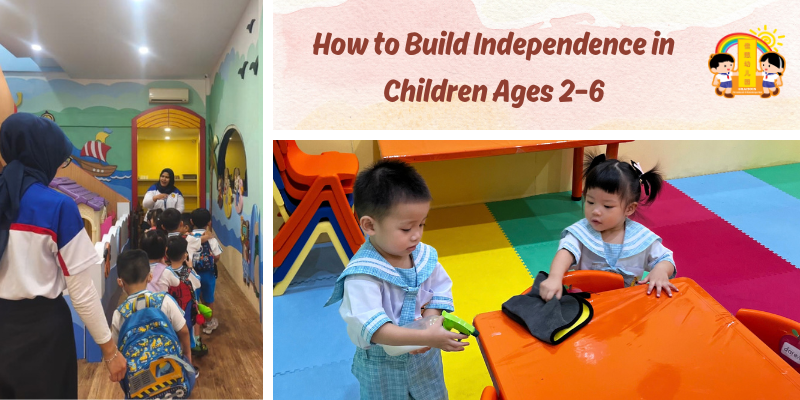
Independence is an important part of a child’s development. From a young age, children naturally want to do things on their own. You may hear them say, “I can do it!” or insist on choosing their own clothes, carrying their belongings, or helping with simple tasks at home.
These moments are more than just expressions of curiosity. They are opportunities for children to develop confidence, responsibility, problem-solving skills, and self-help skills.
For children ages 2–6, independence does not mean expecting them to do everything without help. Instead, it means giving them opportunities to try, make simple choices, practise skills, and gradually take responsibility for things they are capable of doing.
Why is Independence Important for Young Children?
When children are given opportunities to do things independently, they begin to develop confidence in their own abilities.
A child who learns to put away their toys, put on their shoes, or pack their school bag begins to understand:
“I can do things by myself.”
This sense of capability can encourage children to become more confident when facing new challenges.
Independence also helps children develop important life skills such as:
- Responsibility
- Confidence
- Problem-solving
- Decision-making
- Self-care
- Perseverance
- Self-control
These skills may seem simple, but they form an important foundation for children's development as they grow.
Independence Looks Different at Every Age
Children develop at different rates, so expectations should always be appropriate for their age and individual abilities.
Ages 2–3: “Let Me Try!”
At this age, children are beginning to explore what they can do on their own.
Parents can encourage them to:
- Put toys back after playing.
- Choose between two clothing options.
- Eat independently using appropriate utensils.
- Put simple items into a bag.
- Wash and dry their hands with guidance.
- Help put shoes or sandals in their place.
At this stage, children may need plenty of guidance. The goal is not perfection but giving them opportunities to try.
Ages 3–4: “I Can Help!”
Children at this age can gradually take on more simple responsibilities.
They can be encouraged to:
- Put away their belongings.
- Put on and take off simple clothing items.
- Tidy up after an activity.
- Carry their own school bag.
- Help prepare simple items for school.
- Wash their hands independently.
- Choose between appropriate options.
Parents can use simple instructions and allow children enough time to complete the task.
Ages 4–5: “I Can Do It Myself!”
As children become more capable, they can begin managing more parts of their daily routines.
They may be encouraged to:
- Dress themselves with minimal assistance.
- Organise their school belongings.
- Put away books and toys.
- Help set the table.
- Clean up after activities.
- Prepare simple personal items.
- Follow simple daily routines independently.
At this stage, parents can gradually reduce assistance while remaining available when children need support.
Ages 5–6: “I Can Take Responsibility!”
Children approaching school age can begin taking greater responsibility for their routines and belongings.
They can practise:
- Preparing their school bag.
- Organising their personal belongings.
- Choosing appropriate clothing.
- Keeping their room or play area tidy.
- Completing simple tasks before moving on to play.
- Following a daily routine.
- Asking for help when they genuinely need it.
The goal is not for children to be completely independent. Rather, they are learning to recognise what they can do, what they need help with, and how to take responsibility for their actions.
1. Give Children Time to Try
One of the biggest challenges in developing independence is giving children enough time.
Adults can often complete a task much faster. When a child takes five minutes to put on their shoes, it may be tempting to step in immediately.
However, constantly doing things for children can reduce their opportunities to practise.
Whenever possible, give them a little extra time to try first.
Instead of immediately saying:
“Let me do it for you.”
Try:
“Would you like to try first? I’ll help you if you need me.”
This simple change can encourage children to become more confident in trying new things.
2. Offer Simple Choices
Giving children appropriate choices is another way to encourage independence.
Instead of asking an open-ended question such as, “What do you want to wear?”, parents can offer two suitable options:
“Would you like the blue shirt or the yellow shirt?”
This allows children to practise making decisions while keeping the choices manageable.
Simple choices can also be offered during meals, play, or daily routines.
3. Let Children Experience Small Responsibilities
Children can learn responsibility through everyday tasks.
For example:
- Returning toys to their place.
- Putting dirty clothes in the laundry basket.
- Carrying their own water bottle.
- Putting books back on the shelf.
- Helping clean up after an activity.
These tasks may seem small, but they help children understand that they have a role to play in caring for themselves and their environment.
4. Avoid Doing Everything for Them
Parents naturally want to help their children, especially when they are struggling. However, there is an important difference between helping and doing everything for them.
When a child is capable of completing a task with a little support, try to provide just enough assistance to help them continue.
For example, if a child is struggling to put on their shoes, instead of doing the entire task, a parent might help position the shoe and let the child finish putting it on.
This approach allows children to experience success while still receiving appropriate support.
5. Praise Effort and Progress
Independence develops gradually. Children will not always complete tasks perfectly.
Instead of focusing only on the result, recognise their effort.
You might say:
“You tried to put your shoes on by yourself!”
or
“You remembered to put your toys away. Well done!”
Specific encouragement helps children understand which behaviours they are doing well and encourages them to keep practising.
6. Allow Children to Make Mistakes
Mistakes are a natural part of learning.
A child may spill water, put their shoes on the wrong feet, or forget to put something away. These moments can become learning opportunities.
Whenever the situation is safe, allow children to experience small mistakes and think about how they can try again.
Instead of immediately correcting everything, try asking:
“What do you think we can do?”
This encourages children to develop problem-solving skills and become more comfortable with trying again.
7. Create Consistent Routines
Children are more likely to become independent when they know what to expect.
Simple routines such as:
Wake up → Get dressed → Have breakfast → Prepare school bag → Go to school
can help children understand what comes next.
Visual schedules can also be helpful, especially for younger children. When routines are consistent, children gradually begin to complete familiar steps without needing constant reminders.
Building Independence at School
At Gracious Preschool & Kindergarten, we believe that independence is an important part of children's early development.
Children are given opportunities to practise age-appropriate self-help skills and take responsibility for their belongings and daily routines. Teachers provide guidance and encouragement while allowing children to try things independently whenever appropriate.
Simple moments such as putting belongings in the right place, tidying up after activities, following classroom routines, or completing a task independently can become valuable learning experiences.
We believe that children learn not only from what teachers tell them, but also from what they are given the opportunity to experience and practise.
Independence Begins with Small Steps
Building independence does not happen overnight. It develops through many small opportunities repeated every day.
A child putting away one toy today may eventually learn to tidy up an entire play area. A child who needs help getting dressed today may gradually learn to manage their own routine. Each small achievement becomes part of a bigger journey toward confidence and responsibility.
Most importantly, children need adults who are patient, supportive, and willing to let them try.
When we give children the opportunity to say, “I can do it!”, we are not simply teaching them how to complete a task. We are helping them build confidence in themselves and their abilities.
At home and at school, let's give children the time, space, and encouragement they need to grow into confident, responsible, and independent learners.
Small steps today can build confident independence for tomorrow.